
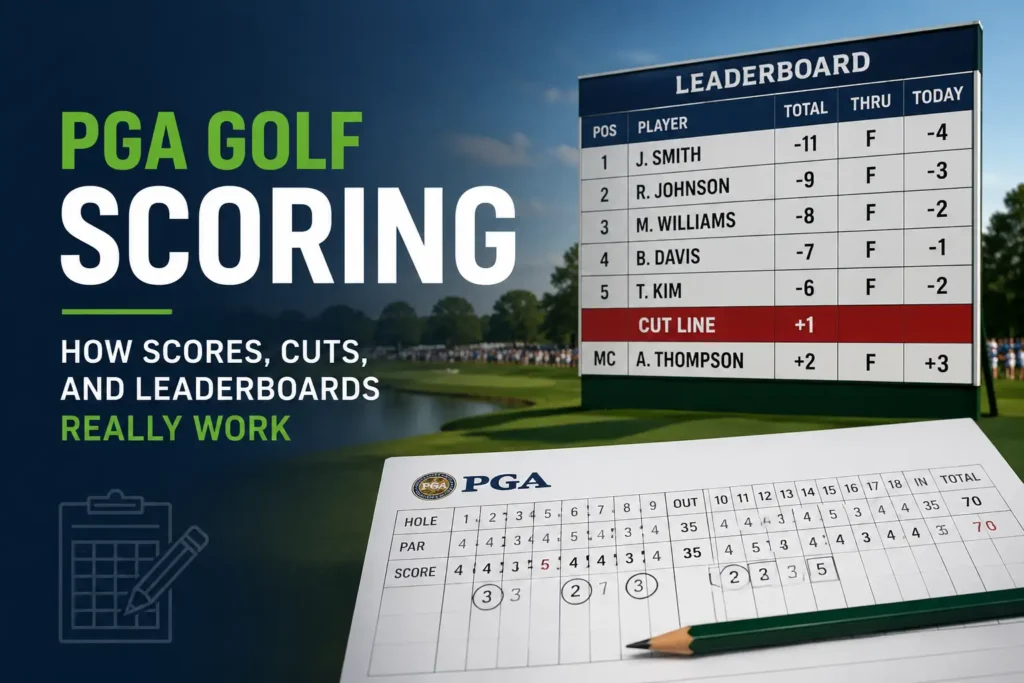
If you have ever stared at a leaderboard full of red and black numbers and felt confused, you are not alone. PGA golf scoring is usually stroke play played over four rounds, with every shot counted across 72 holes and the lowest total winning, while scores are often shown in relation to par for a quicker read. For beginners learning the basics and regular golfers who want to make more sense of PGA TOUR leaderboards, this guide breaks down hole scores, round and tournament totals, cut lines, leaderboard symbols, match play and Stableford formats, handicaps, official scoring procedures, and how to follow live scoring. Once those pieces click, broadcasts are easier to follow and it becomes much simpler to use pro scoring ideas in your own weekend round.
Quick Answer: How PGA TOUR Scoring Works
PGA TOUR events, including the Rocket Classic at Detroit Golf Club in Detroit, MI, are almost always decided by stroke play over four rounds. Stroke play counts every single shot taken over a set number of holes, usually 72, and the player with the lowest overall score wins; that lowest total is also what a player must post to win the event.
The goal in a PGA golf tournament is to complete 18 holes using the fewest number of strokes possible. Lower scores are better in golf scoring, which is the opposite of team sports like the NHL where accumulating points is the objective. Each hole produces a hole score (birdie, par, bogey, etc.), which rolls into a round score (say, 68), and four round scores combine into a tournament total score.

At the 2025 Rocket Classic, winner Aldrich Potgieter finished at −22 (266 total strokes on a par-70 course). TV leaderboards displayed that −22 figure prominently because it tells you instantly how dominant a performance was. PrimeTopGolf offers free score calculators that let both the player and their friends track PGA-style scoring during casual rounds.
- Tournaments typically consist of 72 holes played over four rounds (Thursday–Sunday).
- In stroke play, total strokes determine the winner.
- PGA Tour events primarily use stroke play as their scoring format.
- Leaderboards show scores relative to par for quick comparison.
Par, Birdie, Bogey and More: Understanding PGA TOUR Hole Scores
PGA golf scoring starts at the hole level: every shot on each hole contributes to your final number. Par is the expected number of strokes for a hole, set by the golf course designer based on hole length and difficulty. Holes are rated as a par 3, par 4, or par 5, and the course rating system considers factors like elevation and hazards when establishing these values.
Scoring below par is the target. A birdie is one stroke under par on a hole-for example, making a 3 on a par-4. Completing a hole in two strokes under par is called an eagle, such as holing out in 3 on a par-5. An albatross is three strokes under par on a hole, and these are extraordinarily rare; there were only five albatrosses across the entire 2024 PGA TOUR season. A condor is four strokes under par on a hole-essentially never seen in professional competition.
Going the other direction, a bogey is one stroke over par on a hole. Completing a hole in two strokes over par is called a double bogey, and triple bogeys (+3) happen more often than pros would like to admit. Even four strokes over par on one hole can destroy an otherwise solid round.
On TV, graphics translate these hole scores into running totals in real time. You might see “Schauffele is −5 through 12 holes,” meaning his cumulative performance across those completed holes sits five under par for the day.
Round Scores, Total Scores, and “Under Par” on the PGA TOUR
PGA TOUR events like the Rocket Classic are 72-hole stroke play events-four rounds of 18 holes each, typically Thursday through Sunday. A standard 18-hole course usually has a total par of 72, though Detroit Golf Club plays as par-70.
A single-round score is the sum of all 18 hole scores. If you shoot 67 on a par-72 course, that is −5 for the day. Tournament scores are usually described relative to par, indicating strokes above or below the course standard. Under par means scoring fewer total strokes than the combined par of the holes completed, while over par means the opposite. Even par is a score that matches the exact cumulative par of the holes played.
Consider Potgieter’s 2025 Rocket Classic performance: he shot rounds of 62, 70, 65, and 69. That adds up to 266 total strokes, or −22 relative to par on a par-70 course. The leaderboard often shows scores relative to par for easier comparison, which is why broadcasts favor −22 over the raw 270 or 266. If two players finish with the same number of total strokes, they are tied and may enter a playoff.
Both the player and their marker must be able to reconstruct the full round from the scorecard, hole by hole, before they sign and return it. A mistake here can lead to serious problems, as we will cover later.

Gross vs Net: Handicaps and Scoring Like the Pros
PGA TOUR professionals always play gross scoring-no handicap adjustments, no safety net. Gross score is simply the actual strokes taken plus any penalty strokes. But most amateurs rely on handicaps to create net scores, leveling the playing field between players of different abilities.
Here is a concrete example: an amateur with a handicap of 15 who shoots a gross 90 has a net score of 75. Handicap strokes are distributed across the hardest holes first, so receiving a stroke on the number-one handicap hole means a 5 on a par-4 counts as a net par. This system allows both the player with a higher handicap and a low-handicap friend to compete fairly, whether they are playing match play or stroke play at their local course.
At PGA TOUR events-including majors where club pros occasionally qualify-everyone competes without handicaps against the field. If you want to mirror professional formats at your home club, PrimeTopGolf’s golf handicap calculator and handicap guide can help you track and apply your index correctly.
Stroke Play, Match Play, and Stableford: Main PGA TOUR Golf Scoring Formats
Professional golf uses several scoring formats, including stroke play, match play, and modified Stableford. While the PGA TOUR is dominated by stroke play, understanding all three formats makes you a sharper fan and a more versatile player.
In stroke play-used throughout the FedExCup season and at the Rocket Classic-the total score across all rounds determines the winner. Penalty strokes add to your count rather than costing you a hole. Players often balance aggression with minimizing mistakes in stroke play, because every single stroke matters from the first tee shot on Thursday to the final putt on Sunday. A player like Dustin Johnson might attack a par-5 going for eagle, but only when the risk-reward math supports it.
Match play compares scores hole-by-hole rather than cumulative totals. Matchplay scores are based on holes won or lost, and a player wins a match in matchplay by leading holes. You will see results written as “3 & 2,” meaning one player led by three holes with only two remaining. Players’ decisions in match play depend heavily on the opponent’s performance-if your opponent hits into the water, you can play conservatively. A loss on one hole is just one hole lost, not a catastrophic blow.
Stableford scoring uses a points system instead of strokes. Modified Stableford awards points based on a player’s score relative to par on each hole-typically two points for par, three for birdie, and zero or negative for bogey and worse. In a modified Stableford system, players earn or lose points based on their performance on each hole, and recovering from a poor hole is easier than in stroke play because losses are capped. PrimeTopGolf’s scoring guides support all three formats so you can pick the style that fits your group.
Cut Line, Field Size, and Weekend Play at the Rocket Classic on the PGA TOUR
Multi-round PGA TOUR events typically start with a full field of 132 to 156 players. After 36 holes-usually at the end of Friday’s round-the field is trimmed. The cut in PGA tournaments occurs after 36 holes, and only the top 65 players and ties make the cut to play the final two rounds.
At a course like Detroit Golf Club (par-70), suppose the cut line after two rounds sits at −4, which translates to 136 total strokes. A player at −4 or better advances, while a player at −3 (137 strokes) has played their last round of the week. Leaderboards on the Rocket Classic site mark these players as “MC” or “CUT,” indicating they were unable to progress to the weekend. It is a short and sometimes brutal end to the tournament for following players who miss by a single stroke.
Some special events operate differently. Limited-field invitationals may have no cut at all, while majors like the PGA Championship sometimes use top 70 and ties. Fans today track the “projected cut” during Friday rounds to see who is in danger of going home early, adding tension to every bogey on the back nine.

Leaderboard Symbols and Status Codes: WD, DQ, Amateur Flags and More
Online leaderboards and TV graphics use shorthand codes to show player status during a PGA TOUR event. Here is what the most common ones mean:
WD stands for “withdrawn.” A player who started the tournament but left-usually due to injury or illness-receives this designation. Their scores before withdrawal stand in the record, but they complete no further play and earn no additional prize money.
DQ means “disqualified.” This applies to serious rules breaches: signing an incorrect scorecard, using non-conforming equipment, or missing tee times without proper notice. Under USGA guidelines, signing for a score lower than actually made results in automatic disqualification-one of the harshest penalties in the sport.
The (a) marker next to a name flags an amateur competing in a professional field, as occasionally happens at the U.S. Open or PGA Championship. These amateurs play under the same rules but cannot collect prize money.
Other symbols you will see: “E” indicates even par, “F” signals a completed round, and “T” before a position number (like T2) means tied. Some digital leaderboards use a dot or live icon to show players still on the course, along with how many holes they have played (e.g., “Thru 12”). Players who began on the back nine with a jul 30 or split-tee start may carry a notation indicating their starting hole.
Hole-by-Hole Coverage: Interpreting Live PGA TOUR Shot Tracking
Modern fans follow PGA golf scoring in real time through shot-by-shot trackers and mobile apps. To view a complete picture of a player’s round, these tools break down every swing.
Consider a typical sequence at the Rocket Classic. A player hits a 280-yard drive into the fairway on a par-4 at Detroit Golf Club, then plays a 190-yard approach shot to the green. From there, two putts-one from 25 feet, a second short tap-in of two strokes worth of putts-and the hole is complete in 4, a par. If instead that approach lands close and the player sinks one putt, it is a birdie, and the round score drops by one.
Standard tracking elements include tee shot location (fairway, rough, or bunker), approach distance, lie description, green-in-regulation status, and putt length. Wind direction, temperature, and green speed are often layered on top, giving context to why scores run higher or lower on a given day.
PrimeTopGolf uses hole-by-hole stats in our tournament breakdowns to analyze trends-like which holes at Detroit Golf Club play hardest. If you are curious about how shot-tracking technology works behind the scenes, we have a full breakdown of Toptracer and similar systems.
Role of Scoring Officials, Markers, and Technology
Behind every PGA TOUR leaderboard is a network of officials, volunteers, and digital systems working to validate every score. The process requires precision, and it is governed by strict rules.
In most pro rounds, one player acts as marker for another, recording that competitor’s hole scores on a physical scorecard. At the end of each round, players must certify their scorecard with their marker’s agreement-both the player and marker sign before turning it in. Scoring officials verify scores for each hole before submission, checking for arithmetic errors and confirming that no rule was misapplied.
The scoring area is a controlled zone. Only players and USGA officials are allowed in the scoring area, and once a player reviews, confirms, and returns the card, it becomes the official record. Scorecards are considered officially returned after players exit the area, and changes after that point are tightly regulated. Scoring officials ensure proper handling of scorecards throughout this process, and any discrepancies can result in a DQ if a player signed for a number lower than their actual score.
In parallel, handheld devices and radio feeds send unofficial hole-by-hole data to central scoring in real time, which powers the live graphics fans see on TV. But the signed, physical scorecard remains the authoritative record-technology supports the check, but paper seals the deal.

Following PGA TOUR Scoring from Home with PrimeTopGolf
Many fans follow the PGA TOUR from home while also tracking their own progress at the local course. Understanding PGA golf scoring makes both activities more rewarding.
A typical online leaderboard shows columns for today’s score, total to par, position (with tied indicators), and round status (through 9, F for finished, etc.). Once you know what each element means-from the cut line to the DQ notation-you can read a leaderboard as fluently as any broadcast analyst. It requires a bit of practice, but the structure is consistent across every event.
Use pro events like the Rocket Classic to learn strategy. Watch how top players attack soft par-5s for eagle opportunities while playing conservative on holes where players failed to avoid big numbers. These patterns translate directly to your own game, whether you are trying to break 90 or shave two strokes off your handicap.
PrimeTopGolf’s equipment reviews and gear recommendations connect directly to performance stats-driving accuracy, putting average, strokes gained-that you see in scoring summaries each week. Understanding how a tour pro’s gear choices affect their scorecard helps you make smarter decisions about your own bag.
At the end of the day, understanding PGA golf scoring makes live tournaments, highlight reels, and personal rounds more meaningful for both the player and fans watching from home. Whether you are decoding a leaderboard during Sunday’s final round or filling out your own scorecard at a municipal course, the language of golf scoring is universal. Explore more scoring guides, calculators, and strategy breakdowns on PrimeTopGolf to make every round count.